Ultimate Due Date Calculator: Accurately Predict Your Baby's Arrival
Finding out you are expecting is one of the most thrilling moments in life. Naturally, the very first question that comes to mind after seeing that positive test is: "When is my baby going to be born?" Using a reliable due date calculator is the quickest and most effective way to estimate when you will get to meet your little one.
Table of Contents
1. Introduction
2. How Does a Pregnancy Due Date Calculator Work?
® Calculating by Last Menstrual Period (LMP)
®. Using Conception Date or IVF Transfer
3. Why Use an Accurate Due Date Calculator?
4. How Reliable is a Due Date Calculator?
5. What to Do After Finding Your Estimated Due Date
6. Conclusion
In this comprehensive guide, we will walk you through exactly how our due date calculator works, the science behind pregnancy math, and what steps you should take next on your beautiful journey to motherhood.
Free Due Date Calculator – Calculate Your Pregnancy Due Date Online
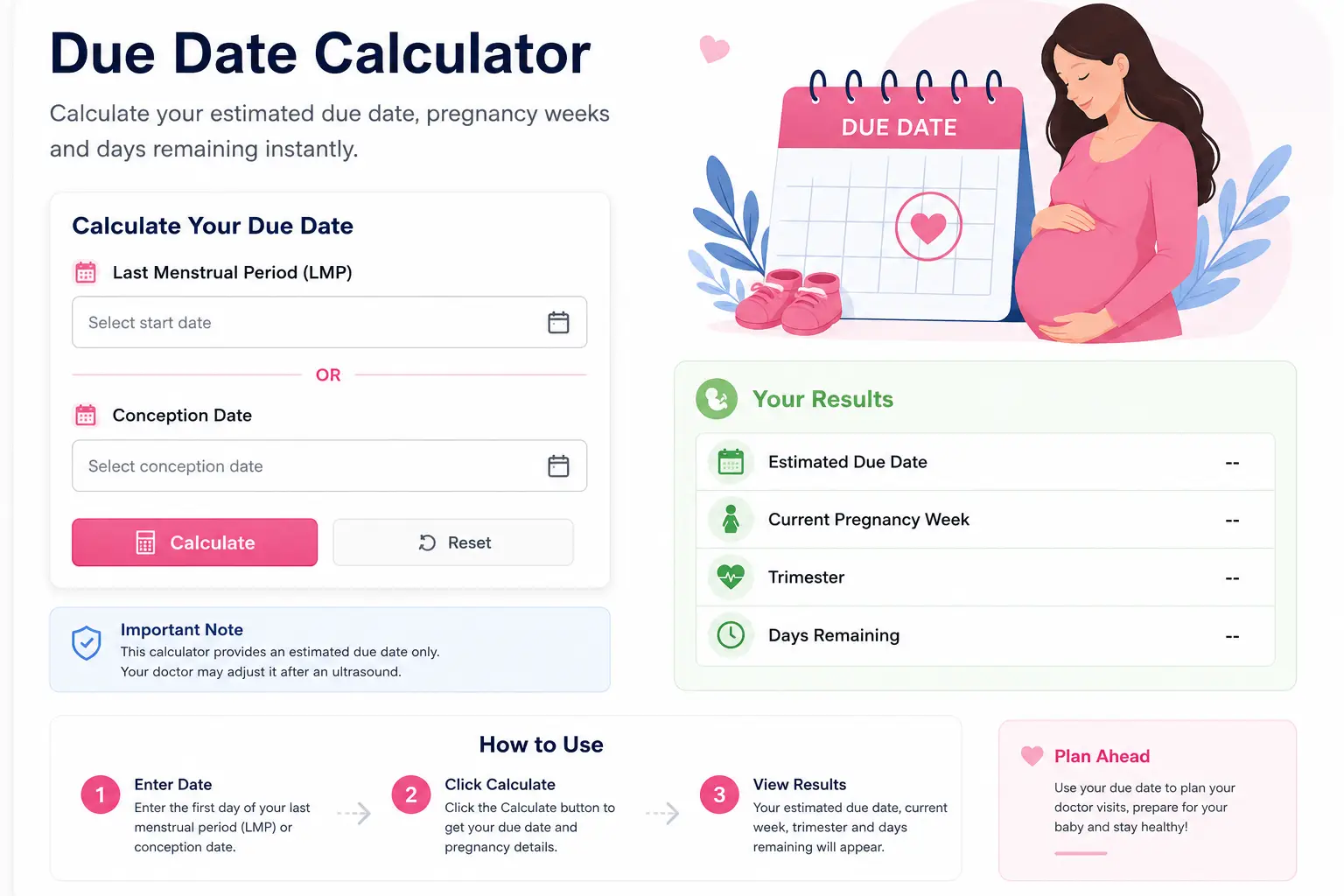
How Does a Pregnancy Due Date Calculator Work?
A pregnancy normally lasts about 280 days, or 40 weeks, starting from the first day of your last normal period. However, trying to count the days on a calendar can be confusing. A due date calculator simplifies this process by doing the medical math for you. It uses a few different primary methods to establish your Estimated Date of Delivery (EDD).
Calculating by Last Menstrual Period (LMP)
The most common method used by both healthcare providers and any standard due date calculator is the LMP method (also known as Naegele's rule). Since most women do not know the exact day they ovulated or conceived, medical
professionals calculate pregnancy from the first day of your Last Menstrual Period.To use this method in our tool, simply input the start date of your last period and the average length of your menstrual cycle. The calculator will add 280 days to your LMP to give you your estimated arrival date.
Using Conception Date or IVF Transfer in Your Due Date Calculator
If you were tracking your ovulation closely or went through In Vitro Fertilization (IVF), you might have more precise data.
®. Conception Date: If you know the exact date of conception, the calculator adds 266 days to that date
®. IVF Transfer: If you had an embryo transfer, the math changes based on whether it was a 3-day or 5-day embryo transfer. Advanced calculators allow you to select your IVF transfer date for a highly accurate result.
(Internal Link Placeholder: Want to know what to eat now that you're expecting? Read our complete First Trimester Nutrition Guide here.)
How Reliable is a Due Date Calculator?
While a due date calculator provides an excellent baseline, it is important to remember that it provides an estimate, not a guarantee. In fact, only about 4% to 5% of babies are born on their exact predicted due date.
Most pregnancies last between 37 and 42 weeks. Factors that can influence when you actually go into labor include:
°. First-time pregnancies: First-time mothers often carry their babies slightly past the 40-week mark.
°. Genetics: Your family history can play a role in gestational length.
° Multiples: If you are carrying twins or triplets, your due date will likely be e. arlier than 40 weeks.
Ultimately, your doctor will use a first-trimester dating ultrasound to confirm or adjust the date provided by the calculator. Ultrasounds performed in the first 12 weeks are considered the most accurate way to date a pregnancy.
What to Do After Finding Your Estimated Due Date
Once you have used the due date calculator and have your date circled on the calendar, the fun truly begins! Here are your next steps:
°. Schedule a prenatal appointment: Call your OB-GYN or midwife to set up your first checkup, which usually takes place around the 8-week mark.
°. Start taking prenatal vitamins: If you haven't already, begin taking a high- quality prenatal vitamin with at least 400 micrograms of folic acid.
°. Adjust your lifestyle: Cut out alcohol, limit caffeine, and review any current medications with your doctor.